



Introduction
Meta advertising has become measurably harder since privacy changes reduced the granularity of tracking available to advertisers. Campaigns built around narrow manual targeting and precise pixel data have struggled. Campaigns built around broad, well-fed automated targeting and first-party data have adapted better.
This is the full-funnel structure we run for clients on Meta — built for the privacy-constrained environment as it actually exists now, not the one that existed five years ago.

The Problem
Many advertisers are still running Meta campaigns structured for a targeting environment that no longer fully exists — narrow interest targeting and granular pixel tracking that's been meaningfully degraded by platform privacy changes.
If your Meta campaigns feel more expensive than they used to, check whether you've implemented Conversions API alongside your pixel — recovering that lost signal is often the single biggest lever available right now.
Running remarketing campaigns without frequency caps can quickly annoy warm audiences and increase costs through ad fatigue. Set and monitor frequency limits, especially for always-on remarketing.
The Solution
Structure campaigns around broad targeting fed by strong creative and first-party conversion data (via the Conversions API), with a genuine full-funnel structure — prospecting, remarketing, and retention — rather than a single undifferentiated campaign.
“The advertisers still struggling on Meta are the ones fighting the platform's shift toward broad, algorithm-driven targeting. The ones winning gave the algorithm better inputs instead.”
— Abhishek, Content & Growth Editor at WebrollerKey Benefits
Resilience to Privacy Changes
Broad targeting fed by first-party data is less exposed to future tracking restrictions than narrow interest-based targeting.
Better Algorithm Learning
Meta's algorithm generally performs better with broader targeting and strong creative signals than with narrow, over-segmented audiences.
Improved Retention ROI
A dedicated retention layer captures repeat purchase value that prospecting-only campaigns leave on the table.
More Reliable Attribution
Server-side tracking via Conversions API recovers signal lost to browser-based tracking restrictions.
Lower Blended CAC
A full-funnel structure lets remarketing and retention efficiency offset higher prospecting costs.
Real-World Examples
Broad targeting with strong creative
A campaign targeting a broad age and location range, relying on creative and Meta's algorithm to find the right audience, often outperforms narrow interest stacking.
Conversions API implementation
Server-side event tracking recovers a meaningful share of conversion signal lost to iOS tracking restrictions and ad blockers.
Retention-specific campaigns
A dedicated campaign targeting existing customers with post-purchase or loyalty offers, separate from prospecting and remarketing budgets.

Case Study
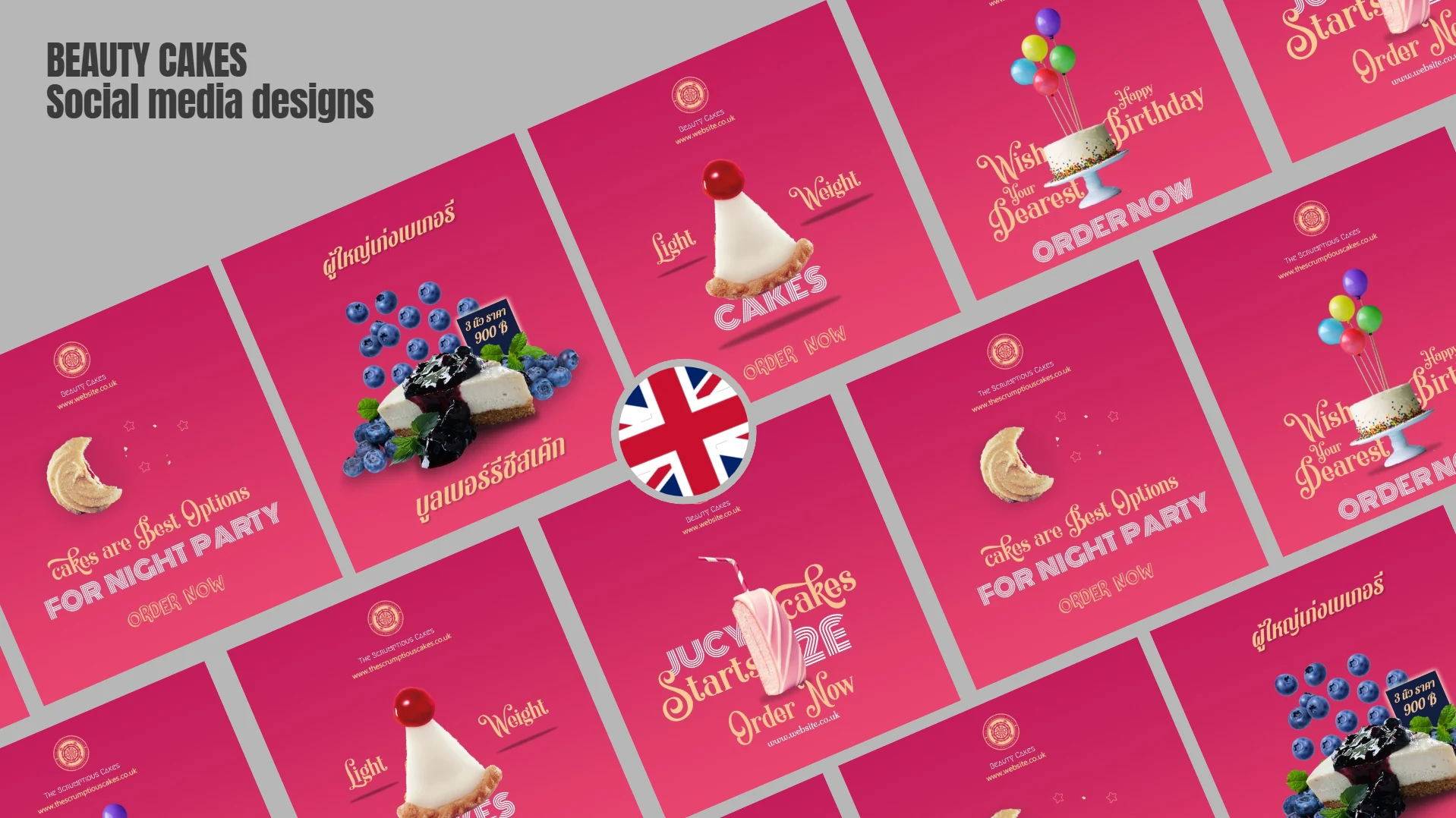
Beauty Cakes
A bold, appetite-first social media creative system for a UK bakery brand.
Beauty Cakes replaced one-off posts with a consistent brand voice, using bilingual seasonal campaigns to turn feed scrolls into cake orders.
Read Full Case StudyBy The Numbers
Practical Tips
- Implement Conversions API alongside the pixel to recover signal lost to browser tracking restrictions.
- Test broad targeting against narrow interest targeting directly — broad often wins in the current environment, but verify for your specific account.
- Build a dedicated retention campaign for existing customers instead of only targeting prospects.
- Segment remarketing by time-since-interaction (day 1, day 7, day 30) with distinct messaging for each.
- Feed the algorithm diverse creative — at least 5–8 active variants — to give it real signal to optimize against.
- Use first-party data (email lists, CRM data) to build lookalike audiences, rather than relying solely on platform interest data.
Best Practices
- Separate prospecting, remarketing, and retention budgets explicitly so performance of each is visible independently.
- Refresh creative on a weekly cadence to avoid fatigue, especially in always-on prospecting campaigns.
- Use UTM parameters consistently so Meta-reported performance can be reconciled against actual revenue data.
- Test Advantage+ shopping campaigns against manually structured campaigns to see which performs better for your specific catalogue.
- Review frequency metrics weekly — rising frequency with declining CTR is an early fatigue signal.
Common Mistakes
- Relying solely on browser-based pixel tracking without implementing server-side Conversions API.
- Over-segmenting audiences into narrow interest stacks that starve the algorithm of learning volume.
- Running only prospecting campaigns with no dedicated remarketing or retention layer.
- Letting the same 2–3 ads run for months without refreshing creative.
- Ignoring first-party data (email, CRM) as an audience source in favour of only platform-native targeting.
Summary
Meta advertising in 2026 rewards broad targeting fed by strong creative and first-party data, structured across a genuine full funnel — prospecting, remarketing, and retention — rather than a single undifferentiated campaign relying on narrow targeting.
Conclusion
The privacy-constrained advertising environment isn't going back to how it was. The accounts performing well have adapted their structure to it — broader targeting, stronger first-party data, and a real retention layer — rather than waiting for the old playbook to start working again.






Really useful breakdown — the point about sequencing (strategy before execution) is something we got backwards on our last project.
Would love a follow-up on how this applies to smaller teams without a dedicated in-house function for this.
Great question, Ananya — we'll add that to our content pipeline. Short answer: the same principles apply, just with tighter scope per phase.